Our other information page:
How healthy is your framed artwork? |
To answer this question we firstly have
to understand the materials from which paper and card are
made. A brief history on the making of paper will show how
some papers have survived for hundreds of years whilst others
have deteriorated very quickly.
Before 1840 nearly all papers were made from cotton or linen
fibres sourced from used clothing. The clothes or 'rags'
as they were called, were cut, mashed, pulped and turned
into sheets of hand-made paper and card. These rag fibres
were both strong and stable thereby producing a paper with
great longevity. The reason for that longevity is due to
the cellulose content of the material used.
Cellulose fibre is derived from plants; cotton and linen are
high in cellulose. By 1840 it was evident that the increase
in the demand for paper was going to outweigh the supply of
rags. An alternate, abundant source of cellulose had to be
found and trees provided the answer. Wood is high in cellulose
fibre but it is also high in lignin. Lignin is a natural component
of wood and after cellulose fibres it is the second most abundant
material in wood. A naturally occurring organic polymer resin,
lignin stiffens the cellulose fibres which give rigidity and
structural strength. Unfortunately, it is unstable and impermanent
and is easily broken down by oxygen and UV light.
This breakdown is part of the natural decomposing of wood.
When a tree dies the lignin is exposed to oxygen and UV
light and then becomes acidic. This chemical and photochemical
degradation is progressive and renders the material 'self
destructive'.
|
| Acid burns paper, indeed the term 'Acid-burn'
is used to describe the damage caused. The paper loses structural
strength, becoming brittle and discoloured. The yellow/brown
discolouration is usually the first sign of acids being present.
Acid-burn is irreversible. Evidence of acids present in paper
is very obvious. Newspaper starts to
go yellow after a day or two, even faster if left in the sun.
Paperback books are another example of acid in paper reacting
to UV light; the outside edges of the book going brown, yet
when the book is opened the pages on the inside still look
white, because the light has not penetrated inside the closed
book. |
The cellulose fibres in wood pulp can only
be regarded as stable if the lignin has been removed. This
process is possible and the term 'Alpha Cellulose' is normally
applied to such materials.
In fact, alpha cellulose fibres derived from cotton, linen,
wood and other plant materials are the longest and strongest
fibres used in paper making. The term 'rag' is still applied
to paper and card made from cotton. It is only the cotton
rag boards and alpha cellulose boards that are recommended
as conservation materials.
Surprisingly, most of the mat boards now being used in picture
framing contain lignin.
The term 'acid-free' is used widely but it depends on the
interpretation. In the Conservation profession, the interpretation
would be:
'Acid-free' - free of acids and free of materials that will
break down to produce acids.
Unfortunately in the Framing Industry the interpretation
can also mean; 'Acid-free' - free of acids at the time of
manufacture.
In this latter case, there is no guarantee that the material
is free of lignin. The reason it is marketed as acid-free
is the addition of a buffering agent to neutralize acids
present. The buffer used is usually calcium carbonate; this
alkaline is a common additive in the manufacture of mat
boards and papers. Not only does it neutralize acids, due
to the presence of lignin, but it is also added to conservation
mat boards and papers to counteract the absorption of atmospheric
gasses and pollutants. Such pollutants as sulphur dioxide
form sulphuric acid which can attack paper. Acids can also
migrate from adjacent acidic materials. The progressive
nature of lignin to become more acidic with the exposure
to oxygen and UV light will over-ride the alkaline reserve
and the mat board will become acidic.
|
| It is obvious that the only interpretation we can depend upon for the well-being and
longevity of artwork is: The materials with which the artwork is in contact with must be free of lignin. |
Have a look at the framed artwork hanging
on your walls. A real tell-tale sign that acidic mat boards
have been used is the discolouration of the bevel cut on
the window mat. If this appears yellow/brown, then the board
is almost certainly acidic. Backing boards such as Masonite,
MDF, Chipboard and Plywood all contain high levels of lignin.
These boards also absorb moisture, providing the acid with
a means of transport into internal framing materials, including
the artwork. These materials will naturally absorb the acid
laden moisture. This process is known as 'acid-migration'.
These backing boards should not be used in conservation
framing.
Acid attack is one source of damage to artwork. There are
many other contributing factors to be considered in keeping
your artwork safe.
If you have questions or concerns about the framing of your
artwork please do not hesitate to contact us, we will be
pleased to help. |
|
| A compound that produces hydrogen ions (H+) in aqueous solution.
The concentration of hydrogen ions in water is known as acidity. |
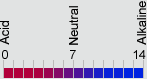
The initials pH stand for 'Potential of Hydrogen'.
The pH scale runs
from 0 to 14 and each number indicates a 10-fold increase. 7 is regarded as pH neutral.
Paper with a pH below 5 is considered highly acidic.
 |
| Lignin is a component of the cell walls of plants that occurs naturally,
along with cellulose. Lignin is largely responsible for the strength and rigidity of plants but its presence
in paper contributes to chemical degradation. |
| The neutralizing of acids in paper by adding an alkaline substance,
usually Calcium Carbonate. The buffer acts as a protection from the acid in the paper or from pollution
in the environment. |
| A very pure form of wood pulp which is considered to have the same longevity
as cotton or other plant fibres. It has the lignin component chemically removed during processing. |
|